
'Resolving Reactivity Success Stories:
Reviews, Testimonials & Real-World Progress
Last updated: July 30, 2026
Success Stories From Resolving Reactivity Members
Last updated: October 13, 2026
Resolving Reactivity has only been available for a little less than 6 months, so we’re still building up our collection of student success stories.
But in that short time, we’ve already received some wonderful feedback from people going through the program. Public reviews, emails sharing their progress, and stories from owners on our live calls with Matt.
Some of these owners are still working through the training. Others have already seen incredible changes in their dogs. Everyone starts in a different place, and some dogs take longer than others.
Below, you can read some of what we’ve heard so far, straight from everyday dog owners who are following Resolving Reactivity and putting the training to work with their own dogs.
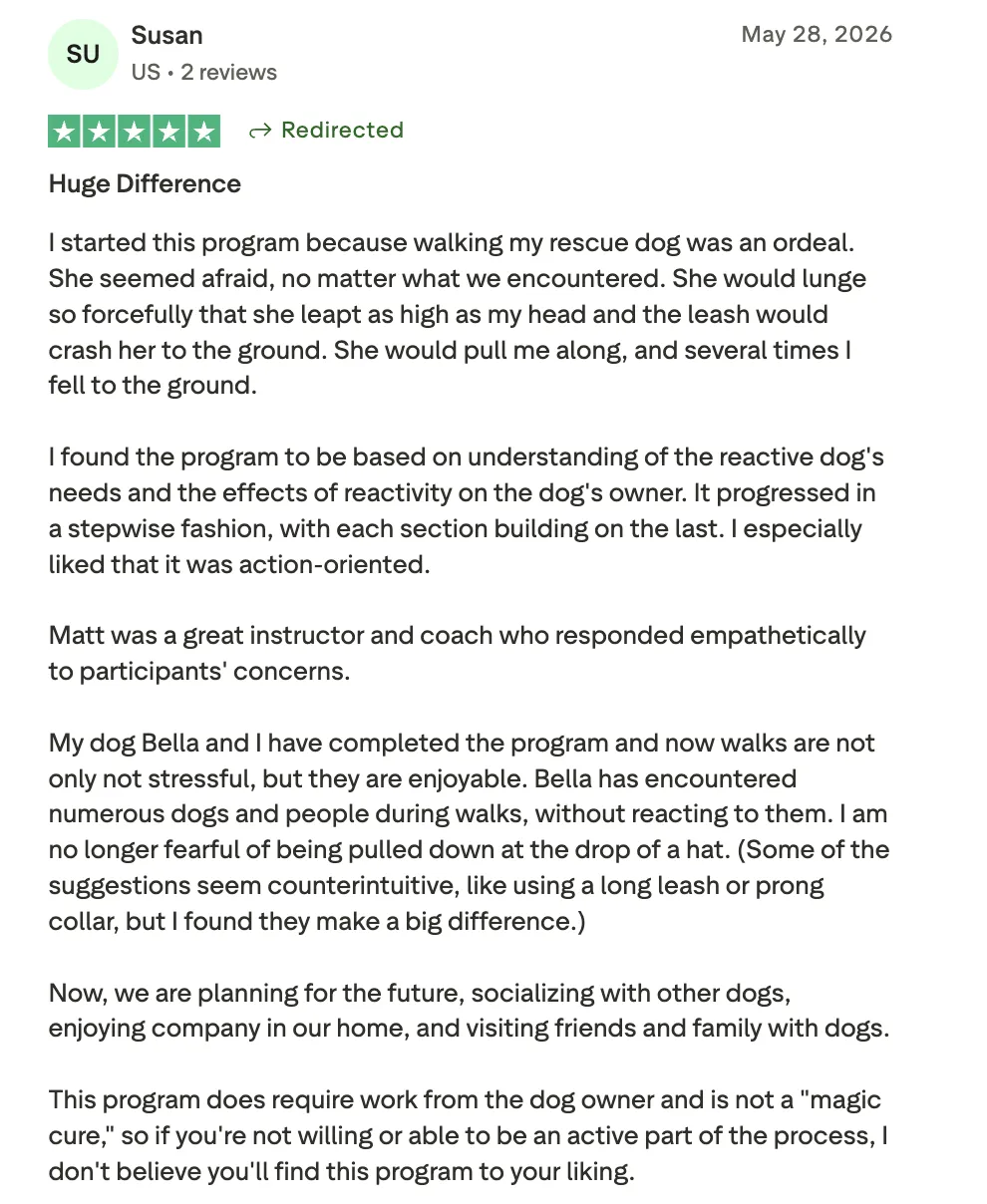
Bella is a 75 lb reactive shelter dog who lunged so hard she pulled Sue to the ground. Now she's a "joy to walk," going to daycare and socializing with extended family dogs.
Sue adopted Bella from a shelter in August 2025. It became clear pretty quickly that Bella did not have much leash experience. She was very reactive on walks, especially around dogs, walkers, and joggers.
And because Bella is a 75 lb pit mix, the pulling was not a small problem. Sue said Bella pulled hard enough that she fell multiple times.
Then Sue started working through Resolving Reactivity.
She found Bella's main fulfillment outlet was sniffing. So their Total Walks changed. They covered less distance, but spent more time out, letting Bella use her nose and actually get what she needed from the walk.
A major turning point came when Bella tried to pull Sue again. Sue had just gone through the Never Again No section, used it in that moment, and said that from that point on, Bella became a joy to walk.
They also worked through Bella bolting after chipmunks. And while chipmunks were still a distraction, Bella became much more compliant.
By the time Sue wrote this, their walks were enjoyable. Bella had started going to half-day daycare, and they were working on visitors and visiting friends and family who have dogs.
In Sue's words
"We adopted Bella from a shelter in August 2025, and it became clear that she did not have a lot of experience walking on leash. She was VERY reactive, barking, lunging, and pulling, especially with dogs, walkers, and joggers. Frequently Bella pulled hard enough for me to fall on multiple occasions."
"A major turning point for Bella and I happened on one walk, where Bella decided to try to pull me. It was an odd thing — she continued to look me in the eye, basically saying 'I can do what I want!' Luckily at that point, I had just listened to 'never again no' and that's what I did. However, from that point on, she has been a joy to walk."
"At this point in time, our walks are enjoyable. We have started taking Bella to 1/2-day daycare a couple of times a week so she can interact with other dogs. We are working on having visitors and visiting with friends and family who have dogs."
"I have nothing but positive feedback about the course and would recommend it to anyone who is interested in doing something about their dog's reactivity."
Matt,
I am very happy with the outcome of this course for me and my dog.
We adopted Bella from a shelter in August 2025, and it became clear that she did not have a lot of experience walking on leash. She was VERY reactive, barking, lunging, and pulling, especially with dogs, walkers, and joggers. Unfortunately, walking Bella, a 75 pound pit mix, pit bull, husky and retriever, became my responsibility entirely because of unexpected health issues in my husband. Frequently Bella pulled hard enough for me to fall on multiple occasions. Then came the harshest winter I can remember, and walks had an extra layer of complexity.
Then came spring and the good news is: I followed the course and would explain action steps to my husband, who reinforced indoors what I was doing on walks.
We found that Bella will play ball, but her jam is sniffing. In fact, our Total Walks have significantly decreased in distance, but increased in time, because Bella sniffs so much!
A major turning point for Bella and I happened on one walk, where Bella decided to try to pull me. It was an odd thing. She continued to look me in the eye, basically saying "I can do what I want!" Luckily at that point, I had just listened to "never again no" and that's what I did. Maybe a little less calmly than I should. However, from that point on, she has been a joy to walk.
I had another issue with Bella bolting after chipmunks, and did the "never again no". Although chipmunks, being everywhere and very active right now, continue to be a distraction, Bella has largely been compliant.
[Constructive course feedback removed for clarity.]
At this point in time, our walks are enjoyable. We have started taking Bella to 1/2-day daycare a couple of times a week so she can interact with other dogs. We are working on having visitors and visiting with friends and family who have dogs. We're still a little hesitant around children, since Bella weighs more than a lot of them!
I have nothing but positive feedback about the course and would recommend it to anyone who is interested in doing something about their dog's reactivity.
— Sue B.
Suzy's dog used to lunge hard enough to take her to the ground. Now her reactions are at a much lower intensity, and Suzy says Matt has given her "hope."
Suzy had been through a lot before Resolving Reactivity. By her own admission, she was embarrassed by how much she had spent and how many ineffective trainers she had tried.
Her biggest issue was her dog's reaction to other dogs. Before the course, those reactions were intense enough that her dog could take her down to the ground with lunges and leash acrobatics.
By the time Suzy wrote in, they were not finished yet. She was up to the Facing the Triggers section, but she knew they were not quite ready for it. Her "No" still needed more work, and she was honest about the fact that adding stress or discomfort was hard for her, especially with an anxious dog.
But even before finishing the process, Suzy was already seeing a huge improvement.
Her dog's lunging and barking around other dogs were happening at a much lower intensity. That mattered a lot, because it made the behavior easier and safer to manage.
And more than anything, Suzy felt hopeful again.
In Suzy's words
"I'm seeing a huge improvement in her reactivity!! Her lunging and barking at dogs is at a much lower intensity, which is critical because previously during a reactivity trigger she could take me down to the ground with her lunges and leash acrobats. HUGE WIN! But I'm so excited at the potential to be able to walk past a dog without a reaction."
"Thanks so much for your invaluable guidance! I'm embarrassed to say how much I've spent, and how many ineffective trainers I've been through. Alas, you have given me hope and that is priceless."
Hey Matt,
Thanks for reaching out. I'm up to the "facing the triggers" section but we are not quite ready for it so I keep doing all the things from previous sections.
The issue is my "No" reinforcer is not yet strong. My dog does not do many things that require a correction, other than losing her mind around other dogs, so it's been slow getting her to understand that "no means no and never again".
Plus, I was trained as a positive reinforcement only trainer and it is difficult for me to add stress, discomfort or pain to my very anxious and insecure dog. But I'm working on me!
Having said that, I'm seeing a huge improvement in her reactivity!! Her lunging and barking at dogs is at a much lower intensity, which is critical because previously during a reactivity trigger she could take me down to the ground with her lunges and leash acrobats. HUGE WIN! But I'm so excited at the potential to be able to walk past a dog without a reaction.
In the meantime, I'm still managing the situation with avoidance as much as possible. We do live in an area with tons of dogs so it's impossible to avoid them everytime. And I walk her twice a day so that compounds the problem with avoiding dogs.
Thanks so much for your invaluable guidance! I'm embarrassed to say how much I've spent, and how many ineffective trainers I've been through. Alas, you have given me hope and that is priceless.
— Suzy L.
Taz still has work to do around other dogs. But bikes, golf carts, and people talking no longer set him off — and after 7 years of barking at Toni's brother, they're now friends.
Toni was still in the Struggle phase when she sent this update. So this was not a "we finished the course and everything is perfect" message.
But a lot had already changed.
Taz loved the long line. He was starting to look back at Toni for direction, which was something he had never done before. Triggers that used to set him off, like bikes, golf carts, and people talking, were no longer causing the same reaction. He could watch them without reacting.
Other dogs were still hard. But even there, Toni said his reactions were better. Less crazy. Passing much quicker.
And there was one huge win outside of walks too.
After 7 years of barking and growling at Toni's brother, Taz and her brother were finally friends.
Toni was honest that they still had work to do. She did not feel like her authority was fully there yet, and she was still looking for consistency before moving forward.
But the progress was real.
In Toni's words
"We are still in the struggle phase but so many things are so much better! Taz loves the long line, he even looks back at me for direction, something he never did. Many triggers that set him off before — bikes, golf carts, people talking — he now watches but doesn't react. Passing other dogs is still a problem but his reaction is better, not as crazy and it passes much quicker."
"We have had one major accomplishment: after 7 yrs of barking and growling at my brother they are now friends and that is huge!!"
Hi Matt!
We are still in the struggle phase but so many things are so much better! Taz loves the long line, he even looks back at me for direction, something he never did. Many triggers that set him off before — bikes, golf carts, people talking — he now watches but doesn't react.
Passing other dogs is still a problem but his reaction is better, not as crazy and it passes much quicker.
Taz really didn't like car rides before but now all you have to say is "wanna go for a freedom walk" and he's ready to go!
[Weather and training logistics removed for clarity.]
Taz is 7 yrs old, adopted him at 1 yr, and all of our training was always rewarded with treats. It has taken awhile to break him of that habit, but we are good with that now.
He knows what he is supposed to do when we stop and I ask him to come but he is super stubborn. Some days he does great, he comes and sits. Other days he acts like he doesn't have a clue! So the struggle is still real for us.
He listens best when he isn't hot and tired so I have shortened the walks and try to get in a few a day instead. I definitely don't have the authority yet but we aren't quitting!
We have had one major accomplishment: after 7 yrs of barking and growling at my brother they are now friends and that is huge!!
Looking for consistency before we move on. Thanks for checking in!
— Toni D.
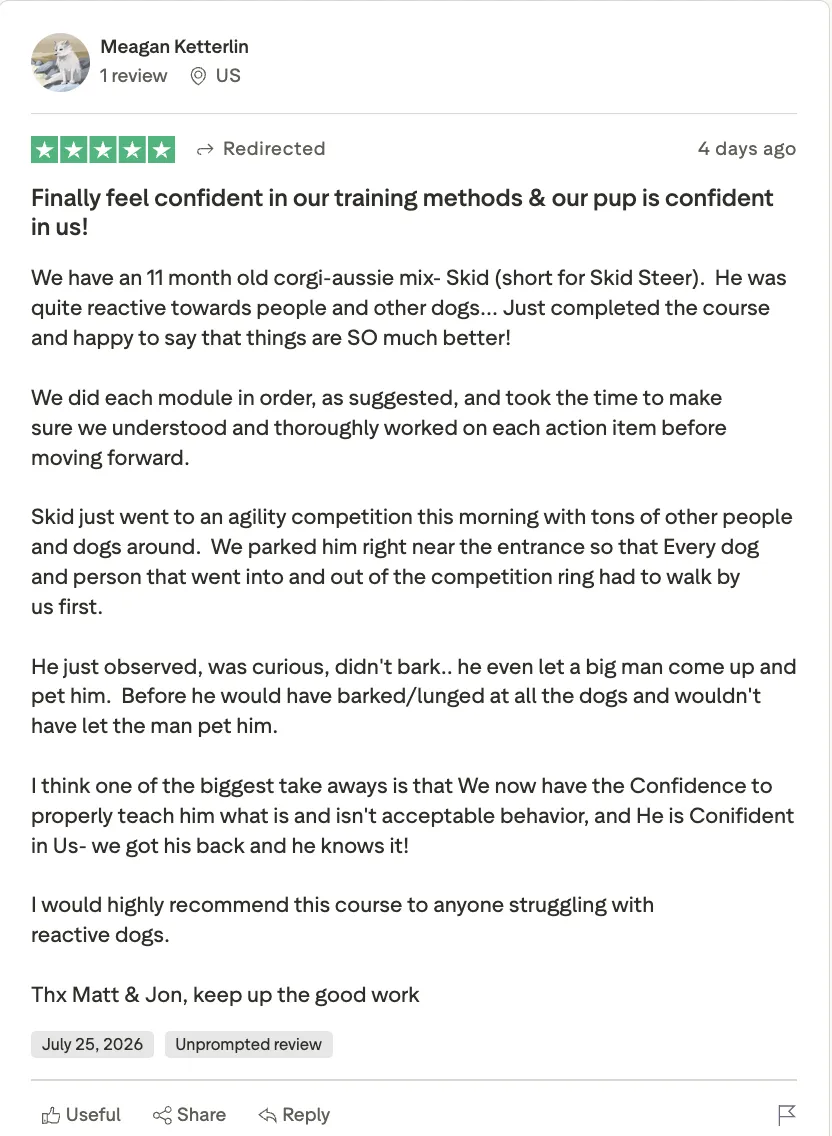
Skid used to bark and lunge at people and dogs. After completing Resolving Reactivity, he sat calmly beside the entrance of an agility competition as dog after dog walked past — and even let a stranger pet him.
Meagan's 11-month-old Corgi-Aussie mix, Skid, was reactive toward both people and other dogs. When either got too close, barking and lunging were normal.
Meagan went through Resolving Reactivity exactly as designed: one module at a time, making sure they understood and worked through each action step before moving forward.
By the time they completed the program, things were "SO much better."
The clearest proof came the morning Skid went to an agility competition packed with people and dogs.
They parked him right near the entrance to the competition ring, which meant virtually every person and dog entering or leaving had to walk directly past him.
Before the course, Meagan says Skid would have barked and lunged at the dogs.
Instead, he simply watched. He was curious, stayed quiet, and didn't bark.
Then a large man approached him — another situation that previously would have caused a reaction — and Skid calmly allowed him to pet him.
For Meagan, though, one of the biggest changes wasn't just Skid's behavior. It was the confidence on both ends of the leash.
She now feels confident teaching Skid what is and isn't acceptable, while Skid has become confident that his people have the situation under control.
In Meagan's words
"Just completed the course and happy to say that things are SO much better!"
"Skid just went to an agility competition this morning with tons of other people and dogs around. We parked him right near the entrance so that Every dog and person that went into and out of the competition ring had to walk by us first."
"He just observed, was curious, didn't bark.. he even let a big man come up and pet him. Before he would have barked/lunged at all the dogs and wouldn't have let the man pet him."
"I think one of the biggest take aways is that We now have the Confidence to properly teach him what is and isn't acceptable behavior, and He is Conifident in Us- we got his back and he knows it!"
"I would highly recommend this course to anyone struggling with reactive dogs."
We have an 11 month old corgi-aussie mix- Skid (short for Skid Steer). He was quite reactive towards people and other dogs... Just completed the course and happy to say that things are SO much better!
We did each module in order, as suggested, and took the time to make sure we understood and thoroughly worked on each action item before moving forward.
Skid just went to an agility competition this morning with tons of other people and dogs around. We parked him right near the entrance so that Every dog and person that went into and out of the competition ring had to walk by us first.
He just observed, was curious, didn't bark.. he even let a big man come up and pet him. Before he would have barked/lunged at all the dogs and wouldn't have let the man pet him.
I think one of the biggest take aways is that We now have the Confidence to properly teach him what is and isn't acceptable behavior, and He is Conifident in Us- we got his back and he knows it!
I would highly recommend this course to anyone struggling with reactive dogs.
Thx Matt & Jon, keep up the good work
— Meagan
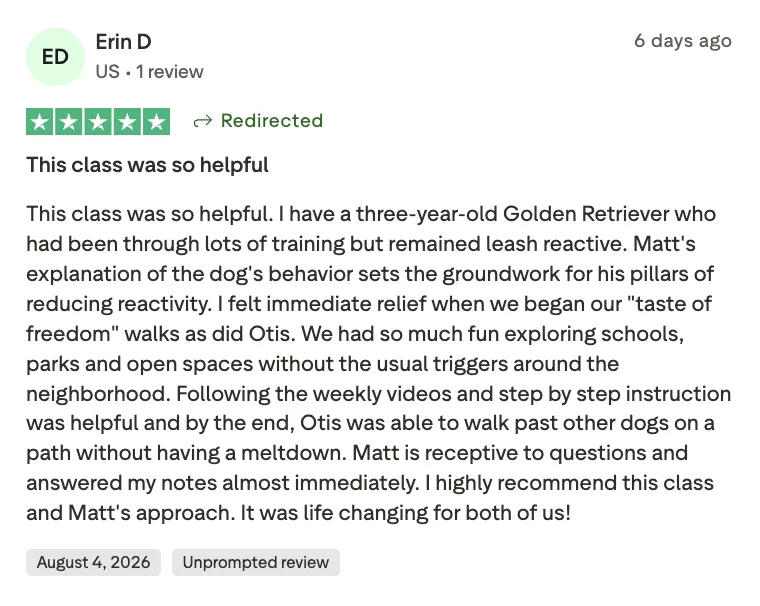
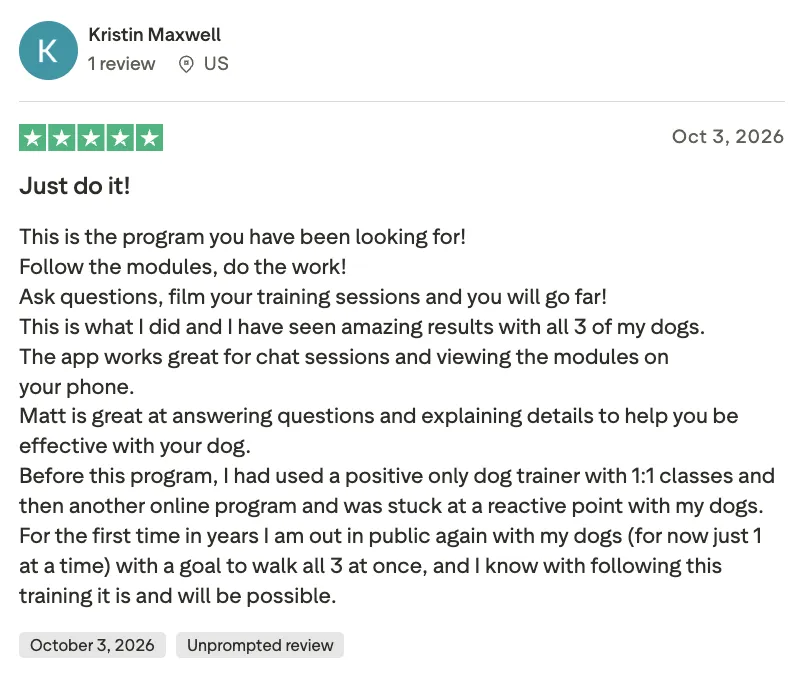
Otis had already been through lots of training but was still leash reactive. By the end of Resolving Reactivity, he could walk past other dogs on a path without having a meltdown.
Erin's 3-year-old Golden Retriever, Otis, had already been through lots of training.
But despite all that work, he remained leash reactive around other dogs.
For Erin, one of the first breakthroughs came almost immediately when they started the Taste of Freedom Walks.
She said both she and Otis felt "immediate relief."
Instead of repeating the same stressful neighborhood walks surrounded by triggers, they started exploring schools, parks, and open spaces together.
And they had fun.
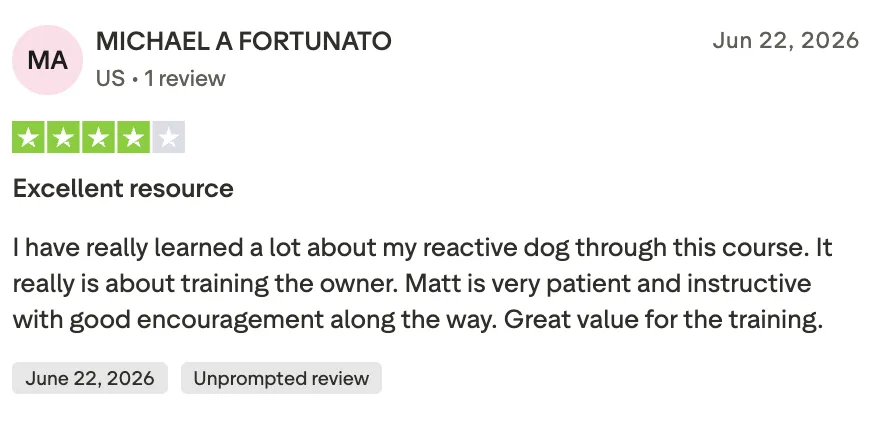
From there, Erin followed the program week by week, using Matt's explanations and step-by-step instructions to understand Otis's behavior and work through the process.
The result became obvious by the end of the course.
Otis could walk down a path, pass other dogs, and keep going — without the meltdowns Erin had been dealing with before.
Erin also appreciated being able to ask Matt questions along the way, saying he responded to her notes almost immediately.
She ultimately described the experience simply: "It was life changing for both of us!"
In Erin's words
"I have a three-year-old Golden Retriever who had been through lots of training but remained leash reactive."
"I felt immediate relief when we began our 'taste of freedom' walks as did Otis. We had so much fun exploring schools, parks and open spaces without the usual triggers around the neighborhood."
"Following the weekly videos and step by step instruction was helpful and by the end, Otis was able to walk past other dogs on a path without having a meltdown."
"I highly recommend this class and Matt's approach. It was life changing for both of us!"
This class was so helpful. I have a three-year-old Golden Retriever who had been through lots of training but remained leash reactive.
Matt's explanation of the dog's behavior sets the groundwork for his pillars of reducing reactivity.
I felt immediate relief when we began our "taste of freedom" walks as did Otis. We had so much fun exploring schools, parks and open spaces without the usual triggers around the neighborhood.
Following the weekly videos and step by step instruction was helpful and by the end, Otis was able to walk past other dogs on a path without having a meltdown.
Matt is receptive to questions and answered my notes almost immediately.
I highly recommend this class and Matt's approach. It was life changing for both of us!
— Erin
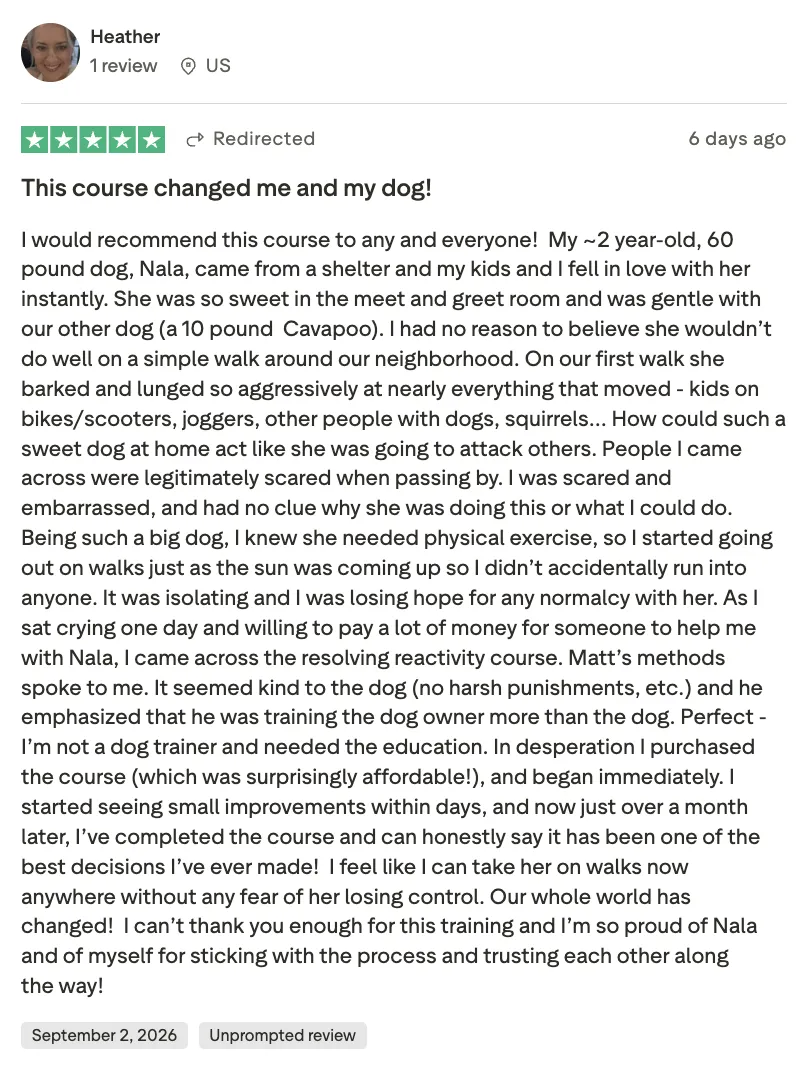
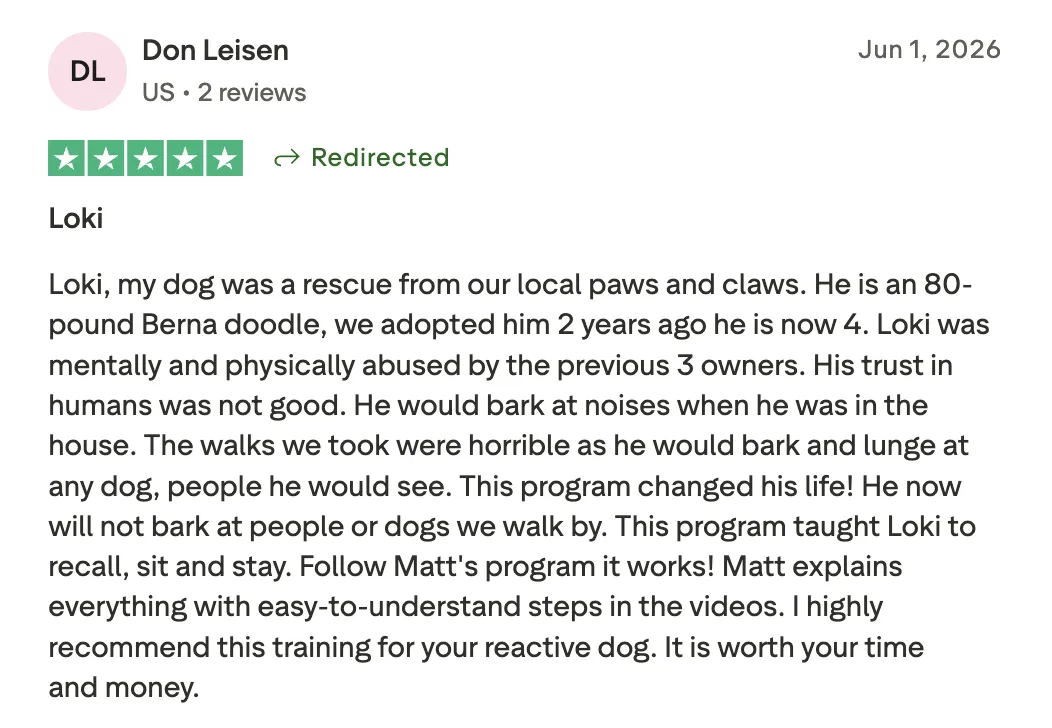
Walks with Loki used to be "horrible." Don had to cross the street to avoid people and dogs while Loki barked and lunged. Five weeks later, "Loki's whole life changed."
Don adopted Loki from a local rescue. Loki was 4 years old when Don wrote his review, and according to Don, he came from a hard background with multiple previous owners.
His trust in people was not good.
Inside the house, Loki would bark at noises. On walks, things were worse. Don said their walks were "horrible" because Loki would bark and lunge at any dog or person he saw.
Then Don started Resolving Reactivity.
By the time he left his review, Loki was walking past people and dogs without barking. Don credited the program with changing Loki's life.
In Don's words
"Loki, my dog, was a rescue from our local paws and claws. He is an 80-pound Bernedoodle. We adopted him 2 years ago; he is now 4. Loki came from a hard background with previous owners, and his trust in humans was not good. He would bark at noises when he was in the house.
The walks we took were horrible as he would bark and lunge at any dog or people he would see.
This program changed his life! He now will not bark at people or dogs we walk by. This program taught Loki to recall, sit and stay. Follow Matt's program, it works! Matt explains everything with easy-to-understand steps in the videos.
I highly recommend this training for your reactive dog. It is worth your time and money."
— Don
Jody tried everything for 3 years. After just a few weeks in Resolving Reactivity, Daisy's reactions went from a 10/10 to a 2 or 3/10.
Jody had trained lots of dogs before Daisy.
But Daisy was different.
She described her as "blip on the horizon reactive," meaning Daisy could see a trigger far in the distance and still explode. After 3 years of trying just about everything, Jody felt like nothing had made a dent.
Her world with Daisy had gotten small.
Then she started Resolving Reactivity.
A few weeks into the course, after beginning the Freedom Walks, Daisy was getting triggered less often. And when she did react, the reaction was dramatically smaller. Jody said Daisy's reactions dropped from a 10 out of 10 to a 2 or 3 out of 10 when triggers got too close.
But the change wasn't just about the reactions. Daisy was more relaxed. Jody felt closer to her. And for the first time in a long time, Daisy's world started to feel bigger again.
In Jody's words
"I started the course and the long line immediately made a huge difference. I've been doing the Freedom Walks for a few weeks and she's progressively become so much less triggered, it's truly astounding.
Now when she sees triggers she sometimes reacts a little, if they're too close, but it's a 2 or 3 out of her previous 10 reaction. Even if this is as good as it gets, it's so much better than where we started.
Our relationship also improved noticeably. We're closer, and she's just generally more relaxed. I'm so thrilled for her, because she's such a good dog and deserves a full life."
"This is easily the most effective, well thought-out training program I've ever tried, and the only one that's made any difference."
"Keep up the great work. I'm convinced you are saving dogs' lives."
Hi Jon and Matt,
I'm still making my way through but wanted to share a few things that might be helpful since the course is so new.
I've had and trained lots of dogs, but I'd never had a reactive one. I got Daisy from the shelter, and she is the most reactive dog I have ever seen. I see videos of supposedly reactive dogs and just laugh. A pro trainer called her "blip on the horizon reactive," and that's no joke. She's a hot mess. I've tried just about everything over three years and none of it made a dent. I'd resigned myself to constant management and it just made me sad for her. Her world was much too small.
I started the course and the long line immediately made a huge difference. I've been doing the Freedom Walks for a few weeks and she's progressively become so much less triggered, it's truly astounding. Now when she sees triggers she sometimes reacts a little, if they're too close, but it's a 2 or 3 out of her previous 10 reaction. Even if this is as good as it gets, it's so much better than where we started. Our relationship also improved noticeably. We're closer, and she's just generally more relaxed. I'm so thrilled for her, because she's such a good dog and deserves a full life. I can't wait to finish the course and see where we end up. It's been life changing for both of us. Thank you.
[Personal aside removed for privacy.]
Aside from that, this is easily the most effective, well thought-out training program I've ever tried, and the only one that's made any difference. Keep up the great work. I'm convinced you are saving dogs' lives.
— Jody S.
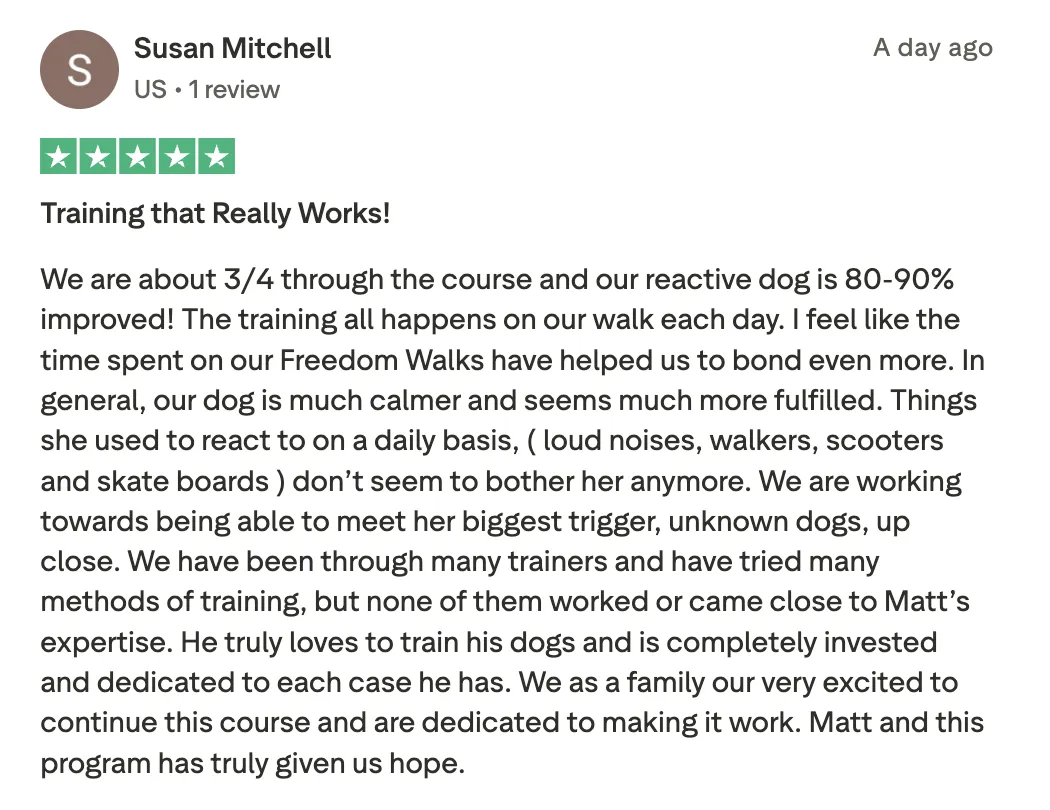
After 1 trainer, 2 online courses, 8 behavior books, and a board & train, Susan says she's "finally getting somewhere."
Susan had already tried a lot before Resolving Reactivity.
A trainer. Two other online courses. Eight dog behavior books. A two-week board and train.
But with Clemmie, they still weren't where they needed to be.
Then Susan started the Freedom Walks.
She said they made a difference right away. As she kept going and added obedience into the walks, Clemmie became calmer on a daily basis, both in and out of the house. She started reacting less to people, bikes, scooters, carts, and loud noises.
She even started ignoring some dogs at a distance.
Susan was still not finished. At the time she wrote this, she was still working on her authority, still practicing the Never Again No, and still avoiding the dog trigger head-on.
But the direction had changed.
Susan felt less anxious leaving the house. She felt more confident when Clemmie saw a trigger. And after everything they had already tried, she finally felt like they had real hope.
In Susan's words
"We are very pleased with Clemmie's progress. As you know, the Freedom Walks made a difference right away. In general she is much more calm on a daily basis, both in and out of the house. She is reacting less to people, bikes, scooters, carts, and loud noises. She is actually ignoring some dogs that are at a distance now.
After one trainer, two other online courses, 8 dog behavior books, and a two week board and train we are finally getting somewhere thanks to you! We finally have real hope."
Dear Matt,
We are very pleased with Clemmie's progress. As you know, the Freedom Walks made a difference right away. Adding obedience to them has been very helpful in her training. I'm still surprised each day that I leave the house with her for her Freedom Walk that I don't need to bring anything with me. In general she is much more calm on a daily basis, both in and out of the house. She is reacting less to people, bikes, scooters, carts, and loud noises. She is actually ignoring some dogs that are at a distance now. I take notes each day to follow her progress more closely. The Freedom Walks alone have helped me to bond with her more than ever. And I feel that we have connected on another level.
As you know, we have introduced the Never Again No for barking at the window or on the porch. I am still working on my authority with her. Most of the time she responds to "Leave It" before needing to say "No". I do feel I need to practice the No more and need more opportunities. We are still avoiding the dog trigger head on for now.
After one trainer, two other online courses, 8 dog behavior books, and a two week board and train we are finally getting somewhere thanks to you! We finally have real hope. I feel a bit more confident leaving the house with her, and in general much less anxious about her seeing a trigger. We still feel we have a bit of work to do, but are excited to move forward. Your videos and Zoom Calls have been so helpful. Thanks so much for all that you have done for us and so many others!
— Susan M.
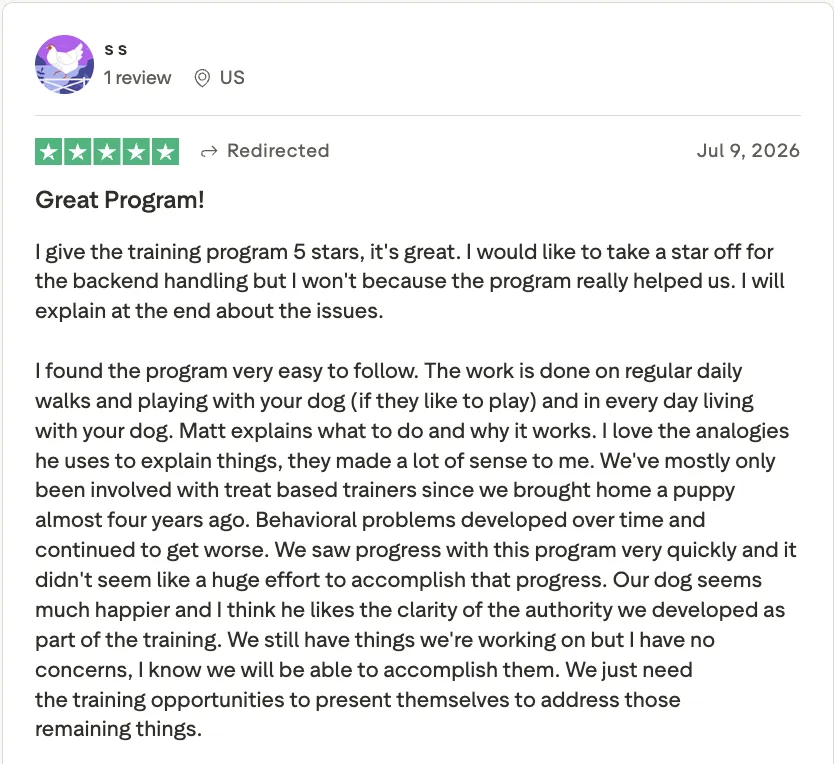
After nearly 4 years of treat-based training while behavioral problems kept getting worse, Sharon saw progress "very quickly" — without it feeling like a huge effort.
Sharon had been working on her dog's behavior almost from the beginning.
For nearly four years, most of the trainers they worked with used treat-based methods. But instead of improving, Sharon said the behavioral problems developed over time and continued to get worse.
Then she started Resolving Reactivity — and began seeing progress very quickly.
One of the biggest differences for Sharon was how simple the training felt. Instead of adding long, complicated training sessions to her day, the work happened during normal daily walks, play, and everyday life with her dog.
She also connected strongly with Matt's explanations. Understanding not just what to do, but why they were doing it, helped the training make sense.
And as they developed clearer authority in their relationship, Sharon noticed something beyond the behavioral progress: her dog seemed happier.
They're still working through a few remaining situations, but Sharon no longer feels uncertain about whether they'll get there. She said she has "no concerns" about their ability to handle the remaining problems as the opportunities arise.
In Sharon's words
"We've mostly only been involved with treat based trainers since we brought home a puppy almost four years ago. Behavioral problems developed over time and continued to get worse."
"We saw progress with this program very quickly and it didn't seem like a huge effort to accomplish that progress."
"Our dog seems much happier and I think he likes the clarity of the authority we developed as part of the training."
"We still have things we're working on but I have no concerns, I know we will be able to accomplish them."
"I really would recommend the program to anyone willing and able to take their dog on daily walks."
I give the training program 5 stars, it's great. The program really helped us.
I found the program very easy to follow. The work is done on regular daily walks and playing with your dog (if they like to play) and in every day living with your dog.
Matt explains what to do and why it works. I love the analogies he uses to explain things, they made a lot of sense to me.
We've mostly only been involved with treat based trainers since we brought home a puppy almost four years ago. Behavioral problems developed over time and continued to get worse.
We saw progress with this program very quickly and it didn't seem like a huge effort to accomplish that progress.
Our dog seems much happier and I think he likes the clarity of the authority we developed as part of the training.
We still have things we're working on but I have no concerns, I know we will be able to accomplish them. We just need the training opportunities to present themselves to address those remaining things.
[Comments about a separate Pack subscription and customer-service issue removed for clarity.]
I really would recommend the program to anyone willing and able to take their dog on daily walks.
— Sharon
After nearly 4 years of treat-based training while behavioral problems kept getting worse, Sharon saw progress "very quickly" — without it feeling like a huge effort.
Sharon had been working on her dog's behavior almost from the beginning.
For nearly four years, most of the trainers they worked with used treat-based methods. But instead of improving, Sharon said the behavioral problems developed over time and continued to get worse.
Then she started Resolving Reactivity — and began seeing progress very quickly.
One of the biggest differences for Sharon was how simple the training felt. Instead of adding long, complicated training sessions to her day, the work happened during normal daily walks, play, and everyday life with her dog.
She also connected strongly with Matt's explanations. Understanding not just what to do, but why they were doing it, helped the training make sense.
And as they developed clearer authority in their relationship, Sharon noticed something beyond the behavioral progress: her dog seemed happier.
They're still working through a few remaining situations, but Sharon no longer feels uncertain about whether they'll get there. She said she has "no concerns" about their ability to handle the remaining problems as the opportunities arise.
In Sharon's words
"We've mostly only been involved with treat based trainers since we brought home a puppy almost four years ago. Behavioral problems developed over time and continued to get worse."
"We saw progress with this program very quickly and it didn't seem like a huge effort to accomplish that progress."
"Our dog seems much happier and I think he likes the clarity of the authority we developed as part of the training."
"We still have things we're working on but I have no concerns, I know we will be able to accomplish them."
"I really would recommend the program to anyone willing and able to take their dog on daily walks."
I give the training program 5 stars, it's great. The program really helped us.
I found the program very easy to follow. The work is done on regular daily walks and playing with your dog (if they like to play) and in every day living with your dog.
Matt explains what to do and why it works. I love the analogies he uses to explain things, they made a lot of sense to me.
We've mostly only been involved with treat based trainers since we brought home a puppy almost four years ago. Behavioral problems developed over time and continued to get worse.
We saw progress with this program very quickly and it didn't seem like a huge effort to accomplish that progress.
Our dog seems much happier and I think he likes the clarity of the authority we developed as part of the training.
We still have things we're working on but I have no concerns, I know we will be able to accomplish them. We just need the training opportunities to present themselves to address those remaining things.
[Comments about a separate Pack subscription and customer-service issue removed for clarity.]
I really would recommend the program to anyone willing and able to take their dog on daily walks.
— Sharon
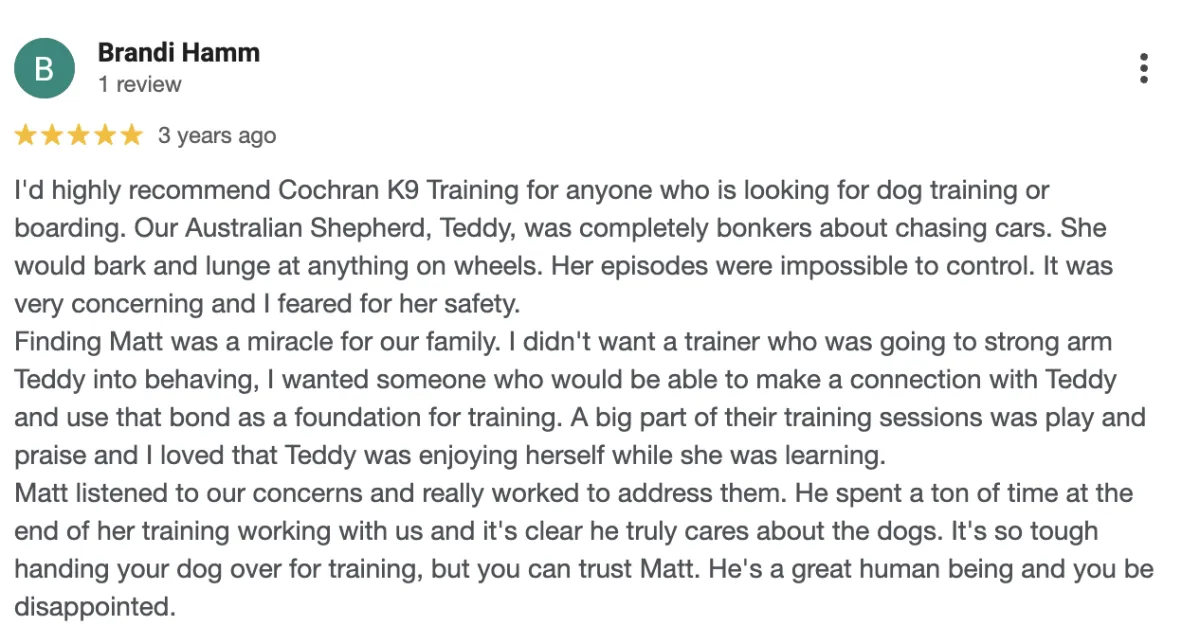
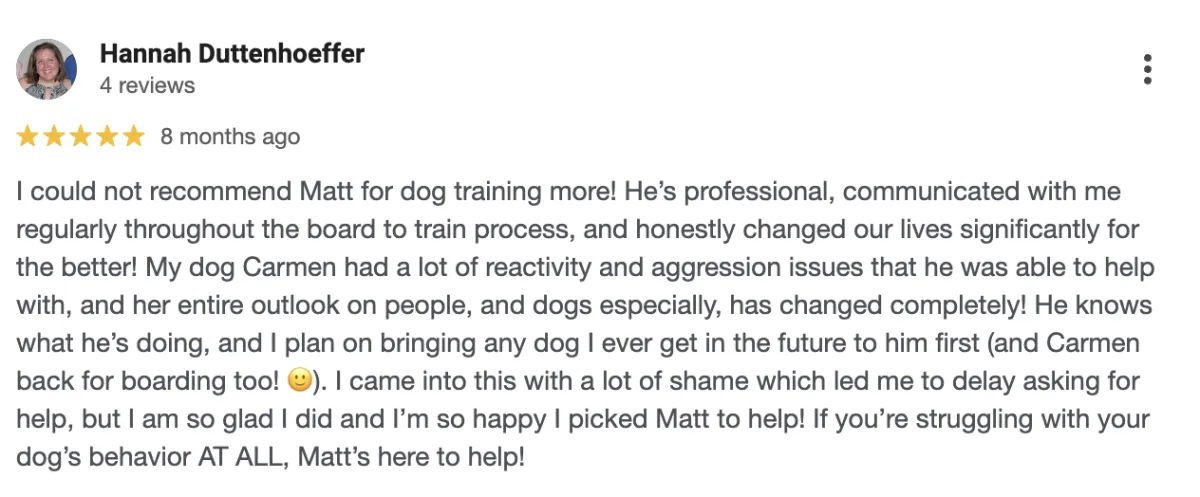
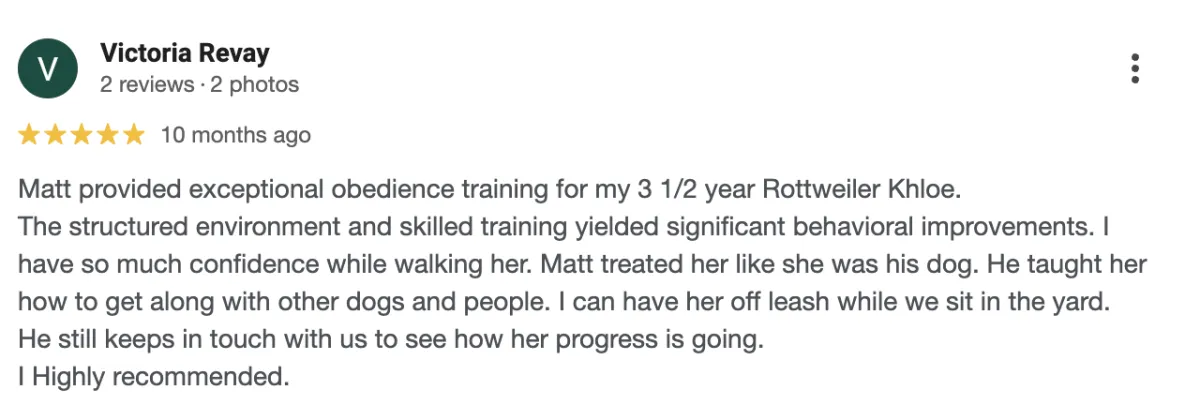
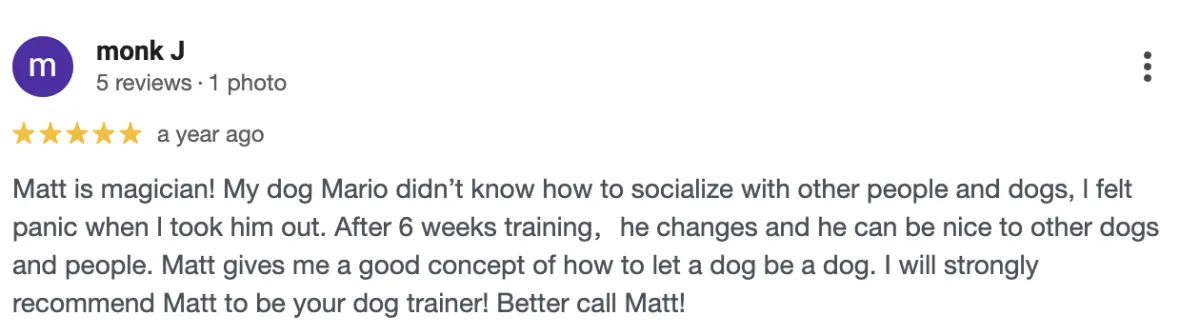
Matt's Client Dog Transformations
Before Resolving Reactivity became a course, this system was built in the real world with Matt’s private client dogs. These cases show what’s possible when the process is applied with clarity, consistency, and the right foundation in place.
Will you get the exact same result as fast as Matt can? Probably not.
But Resolving Reactivity was not built to turn you into Matt overnight. It was built to teach you the same system, step by step, so you can use it with your own dog in your own life.
Because when you do the work, you don’t just get a better dog at the end. You become a better owner and handler. That’s what makes the progress last a lifetime.
(Plus you save yourself $5,000!)
Zoe
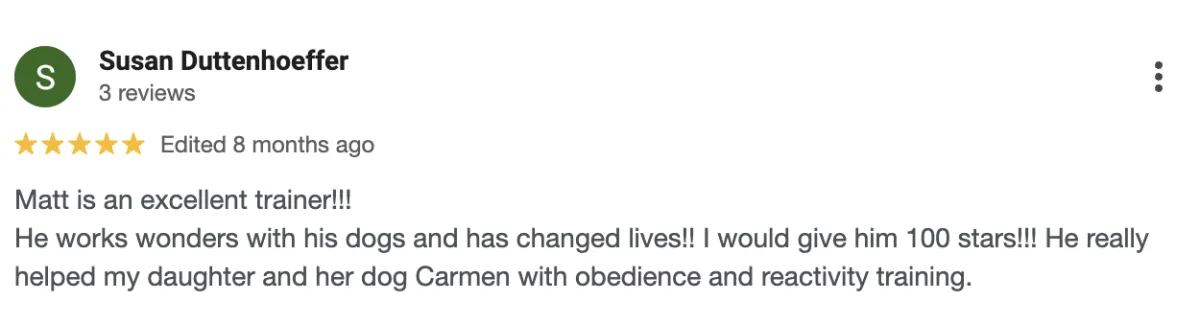
Carmen
Khloe
Auggie
Tonga
Branch
Small Wins From Resolving Reactivity Members
These are not full transformations. They are early updates from members who are starting to see things change as they work through the course.
Enjoyable walks. Less intense reactions. Better recovery. More confidence. Dogs starting to check in, listen, relax, and enjoy the process.
A small win does not mean the reactivity is fully resolved yet. But it does mean the work is starting to pay off. And each small win stacks on top of the last... until you look back and realize you have a totally new dog & life together.